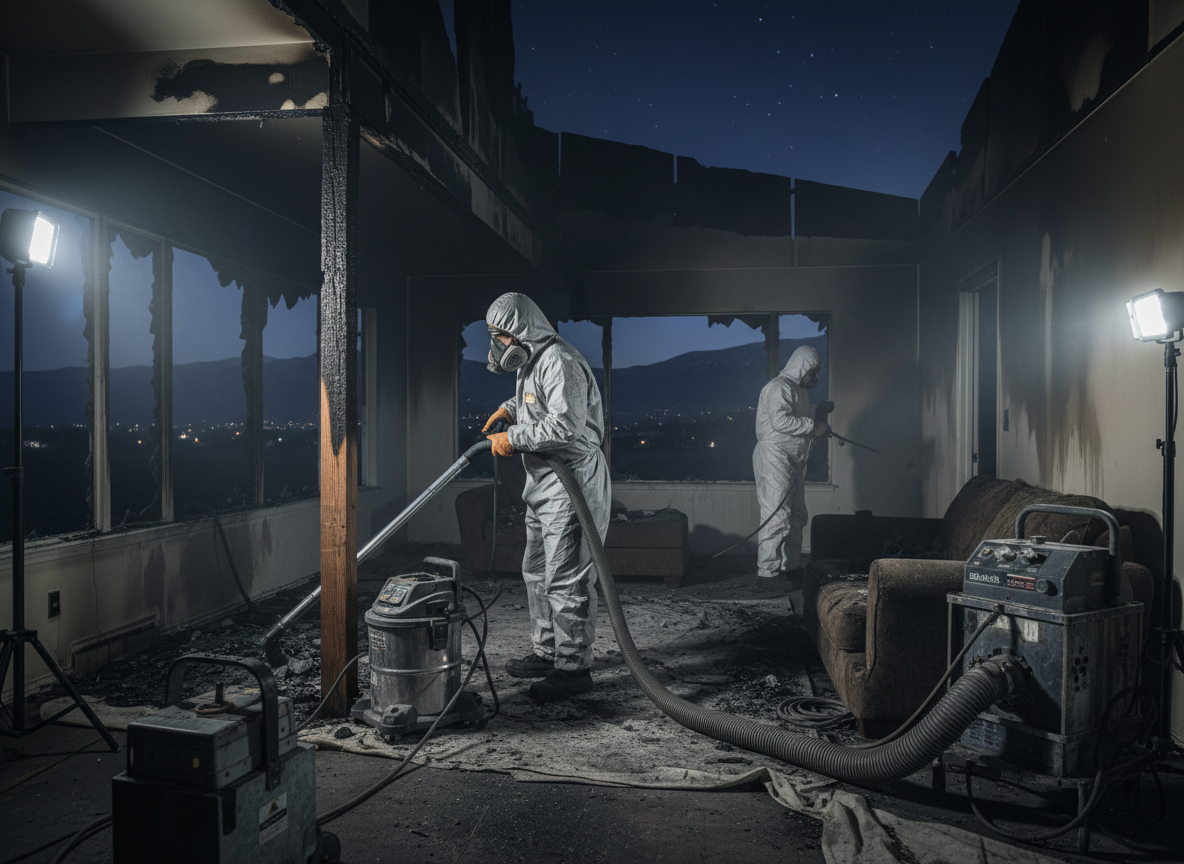
Sun Valley's older housing stock, much of it built mid-century with stucco exteriors and wood framing, holds smoke and soot in ways that newer construction does not. Hot, dry summers with low humidity and occasional Santa Ana winds push embers and fine particulates through vents and under rooflines, especially near Hansen Dam Recreation Area and in the hills of Shadow Hills. When a fire occurs, crews must address both visible char and invisible residue that migrates through HVAC systems and wall cavities common in these homes.
Los Angeles County building codes require proper disposal of fire-damaged materials and verification that no residual hydrocarbons remain before re-occupancy. In neighborhoods like La Tuna Canyon, steep driveways and narrow streets can delay equipment arrival, so 24 hour teams stage smaller response vehicles locally. Dry Mediterranean conditions also mean that water used during suppression can quickly evaporate, leaving behind concentrated alkaline residues that etch concrete slabs and corrode copper wiring if not neutralized promptly.
Rapid board-up prevents further intrusion from wind-driven ash common in Pacoima and Burbank border zones. Technicians test for pH levels on surfaces and use air scrubbers sized for the square footage typical of Sun Valley ranch homes. Delaying these steps allows smoke to bond permanently with porous materials such as drywall and insulation found throughout the area.
Coordination with local utilities is essential because many Sun Valley properties still rely on older electrical panels that can be compromised by heat even when the fire was limited to one room. Crews document conditions room by room before any demolition begins to satisfy insurance requirements common in Los Angeles County.
Technician insight
In Sun Valley, the thing that catches most people out with 24 hour fire restoration is how quickly smoke travels through the single-wall construction common in 1950s homes near Sun Valley Park. Hot dry summers pull fine ash into every seam, and if you wait even one extra day the residue bonds to the plaster and requires far more aggressive cleaning than the same job in a newer Glendale tract home.
Kitchen fire spreads to attic in Shadow Hills
A contained kitchen fire sent smoke into the attic space of a 1960s ranch house. Crews found soot had traveled through the original knob-and-tube wiring runs and settled on insulation. They performed targeted removal, neutralized residues, and restored airflow without full attic replacement.
How it works
- 1
Emergency Dispatch
Technician arrives within hours to assess structural safety and secure the property against weather and unauthorized entry.
- 2
Damage Documentation
Detailed photos and moisture readings are taken to support insurance claims for homes in Sun Valley and adjacent neighborhoods.
- 3
Soot And Residue Removal
Specialized equipment extracts smoke particles from surfaces, HVAC systems, and wall cavities before odors set in.
- 4
Structural Drying And Cleaning
Affected materials are dried and cleaned or removed according to Los Angeles County disposal rules.
- 5
Final Verification
Air quality and surface testing confirm the home meets re-occupancy standards before handover.
Pricing
Cost depends on fire size, affected square footage, and materials involved; upfront quotes provided after inspection.